Zubeen – A Tsunami of Grief and Love
 cnesadmin
By Sanjoy Hazarika | Source link
Assam and many parts of the North-East have risen and marched to the lyrics of a singer whose voice is stilled but whose words span barriers of caste, creed, politics and other identities. A tsunami of love and collective grief coursed through the highways and streets of Guwahati, mourning Assam and the region’s sole Super Star. People walked long distances and stood for hours to pay their respects, they left flowers, gamosas, tears and pieces of shattered hearts. There were complaints about bad crowd management but that’s hardly unexpected when one of the largest concourses in human history descends on a small city by the Brahmaputra.
The collective anguish was expressed in the piercing wails for ‘Zubeen Da’ that rang out when the vehicle carried his body from Guwahati airport; hands reached out to touch the van, tossed petals as it drove by, hundreds knelt on the roadside and cried.
That scene played out over hours as the van inched through an unending sea of people. The state is silent but for the sounds of weeping and cries of occasional anger against people they feel are responsible for this loss (that too will come to pass, inexorably). Shops are closed, markets are shuttered. It is as if there has been a death in every family. There are few dry eyes, even policemen and women are seen weeping and tearing up while doing their duty.
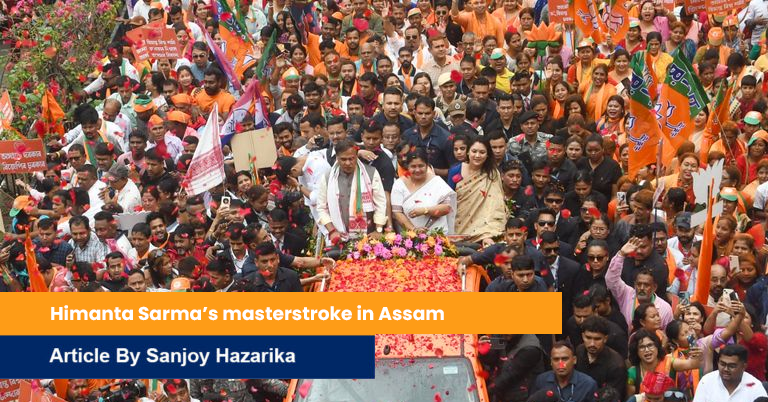
Chief Minister Himanta Biswa Sarma has anchored the flow of information through television, traditional and social media about the programmes with dignity. Zubeen’s grieving wife Garima has shown courage. As the public gathered and filed in an unending stream past the glass casket where his body was kept for public viewing, Zubeen’s songs played ceaselessly over a music system at the Sarusajai sports complex located on the edge of the Assam capital. As they waited, exhausted with grief, cried or sang outside, more streamed along the roads of Guwahati, walking to the cavernous sports arena which seemed to shrink with the masses of people. Traffic stopped. Of course, vehicles carrying ministers, politicians and other so-called VIPs slipped by. No one was interested in them.
On everyone’s mind and heart was one destination, on their lips, one name; from tens of thousands of voices roared not one but his many songs.
It was the same everywhere in Assam. In villages and towns, in cities and neighbourhoods. People marched in thousands on the streets to convey pain and grief, lit up the night with their mobile phone torches as songs poured out and filled the air. Motorcyclists filled the streets in remembrance.
His portraits sprang up everywhere, on flyovers and lamp posts, as buntings across streets, in halls and households, educational institutions, as people lit diyas in respect and laid flowers. Gatherings grew at street corners and shops, homes and offices, schools, colleges and universities across the country to sing his songs and hear his recordings, surging with the purity of passion, the warmth of love and tapping brilliantly into the angst of a generation unsure of itself and coming to grips with a swiftly changing society and world. To them, he was their voice, he sang their words and uncompromisingly he tossed out abuse and challenges at the political class and egoists.
He became a powerful equalizing force with followers across all divides in a struggling and fractured state. But why just Assam? Tributes flowed in from across the country and from neighbouring states.
In Tura, where he was born in 1972, there were prayers and songs. In Shillong, the local Assamese community gathered to mourn and remember while Lou Majaw, the Bob Dylan of the region, spoke of his contribution to the world of music “not just for the people of Assam or the people of North-East or India … He has given himself through his songs and music”. Chief Minister Conrad Sangma sent a message as did Pema Khandu of Arunachal Pradesh who convened ruling party legislators. Arunachal Pradesh has a strong connect to Assamese culture and music especially the late Bhupen Hazarika, who was born there, and to Zubeen Garg.
To me, the throngs mourning Zubeen reminded me of November 2011 when a human sea engulfed Guwahati to receive Bhupen Hazarika. There was a noticeable difference — the huge flow of people which that came to honour Zubeen has been overwhelmingly young.
A young Zubeen burst onto the music scene like a breath of fresh air. With refreshing candour, he often recounted with self-deprecation (for unlike many other stars, he could laugh at himself, a quality that endeared him to millions of followers) how at his first public performance in the oil town of Duliajan, he tripped over a wire and fell flat on his face upon entry onto the stage. He picked himself up and looked out at the audience. (He was to remark later that he had never seen such a large crowd.) Overcoming nerves, he burst into song –the rest was history and the audience, like all later, was mesmerized.
Born Zubeen Borthakur (he later changed his surname to Garg), he kept picking up awards; his fame and following grew. He stunned Bollywood with his Ya Ali from the film Gangster which won him a Global Indian Film Award for best playback singer in 2006. Choosing to turn his back on Bollywood after a few years, he moved to Assam. He acted in Assamese films and even won a National Award for one. He not just directed and acted in movies but also produced them including Mission China where he wrote the screenplay, scored the music, directed and created the story.
This piece is not purported to be a detailed biographical note on him; the space is too limited, the time too less and hence it is difficult to include everything about this super star who sang over 32,000 songs in 40 languages. What many struggle to achieve in many lifetimes, Zubeen achieved seamlessly in a bare 52 years. He was from Assam but belonged to the world, he carried his Assamese identity with him but soared effortlessly and timelessly above human-imposed barriers.
One of my cousins who knew and worked with him closely has described him as a “storm”. “… Zubeen was uncompromising, a spirit so untamed that even the word ‘freedom’ seemed too small to house him. Where others calculated, he leapt. Where others hesitated, he spoke”. With deep honesty and inner pain, D’Com Bhuyan wrote in The Thumbprint: “We lived wildly too, not just in art but in life. The long nights, the laughter that spilled into dawn, the bottles emptied as if they held some secret to the universe. For me, the road led to a reckoning, well I sought help, I learned to wrestle my demons. But Zubeen was different. He was the whirlwind and he was the STORM. Where I chose shelter, he chose the open skies. He lived in the storm because he WAS the storm, impossible to contain, impossible to still”.
I have listened more to Zubeen’s music and songs in the past three days and nights then at any other time in my life. I wish I had done so much earlier. Unlike many others, I never met him nor was I privileged to watch a live performance. Yet, these last days, his music has touched me and I feel a deep connect to him and his faithful followers. Not a song rings through the air without tears moistening my eyes.
As he came to Guwahati on his last journey, a rainbow formed in the sky. The next day, the heavens opened in a torrent of rain to mourn a beloved son. His followers sing Mayabini unceasingly everywhere, the magical song he said should be sung when he died. Roughly translated, some of the lines go like this:
In the heart of this magical night/I can see your face at a distance/You have quietly moved into a hidden corner of my heart/ I have danced with the storm for years/ I had befriended darkness a long time ago. (picture credits Maulee Senapati)