Himanta Sarma’s masterstroke in Assam
 cnesadmin
By Sanjoy Hazarika | Source link
THREE years ago, Himanta Biswa Sarma, then just two years into his first term as a BJP Chief Minister of Assam, had ensured a crucial strategic win that would stand him in good stead in the future. A key number of the state’s 126 constituencies were redrawn, using demography and religious markers to strengthen the BJP’s position and diminish that of his political foes. As a result, his principal adversary, Gaurav Gogoi, the Congress MP and now state Congress party president, was forced to shift base.
It was a masterstroke whose significance was missed by many political leaders as well as media commentators at the time. Today, as state elections loom in Assam, Sarma’s sleight of hand is now evident. Seats where Muslim electors were either a majority or had crucial votes and which were seen as pro-Congress became Hindu-dominant or were reserved for Schedueld Castes or Scheduled Tribes, depriving the Congress of safe constituencies.
At the time, the CM told journalists: “The NRC was unsuccessful and the Assam Accord did not live up to expectations. Delimitation for redrawing Assembly constituencies can be one exercise through which we can safeguard the future of Assam for two decades by at least ensuring the state Assembly is less affected by demographic changes.”
Political analyst Yogendra Yadav recently described the process as one of gerrymandering, but acknowledged that few had paid attention to it over the years. Politically, Sarma has been a step ahead of his opponents much of the time.
The reference to the NRC was to the National Register of Citizens, which was held in Assam (the only state in the country to have it) to establish who were bona fide Indian nationals and, conversely, who were not.
As is well known, Assam has been at the vortex of a bitter and occasionally bloody campaign to identify and drive away “illegal immigrants” said to have come from Bangladesh — a process that has consumed time, energy and harmed goodwill among religious groups since the 1970s.
The NRC turned up, to everyone’s surprise, some 19 lakh people, who enumerators said, could not prove their genuineness — the process was through legacy documentation of ancestors — but the largest group excluded was Hindus and not Muslims, as is widely assumed. Even this was not conclusive and those left out of the picture have not been given a chance to prove their status.
Also, the Assam Accord of 1985 between student agitators and the state and Central governments laid down a cut-off date for immigrants — those who came after 1972 could not qualify for citizenship, thus, virtually creating two levels of citizenship for Indians in Assam.
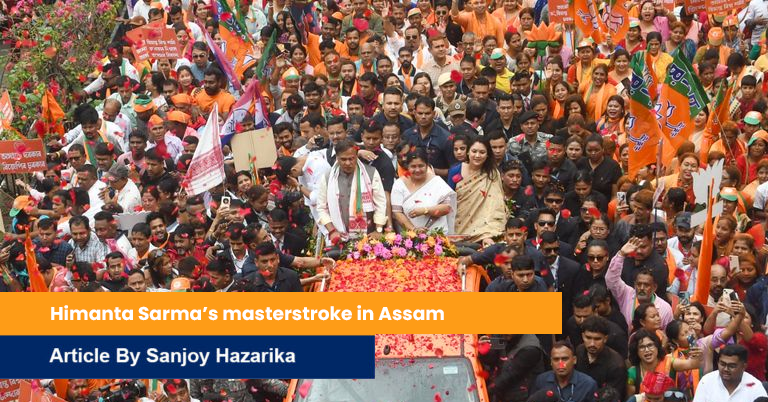
Thus, while these tortuous issues remain unresolved across Assam, the election tempo is yet to pick up. The BJP says that it is expecting to win its third consecutive victory. Home Minister Amit Shah, whose road show in Guwahati created traffic snarls, said the party would get 90 seats.
However, the party has been stung by rebellions by local leaders who were denied tickets and who have come out sharply against the Chief Minister and his allies.
Others have remained silent, like a former state BJP president. The defection of long-time Congress leader Pradyut Bordoloi to the BJP (a two-time Congress MP, he was given the prized Assembly seat of Dispur, where the state’s capital complex is located) stunned the Congress but also caused angry ripples in the public realm about switching allegiances.
A burst of memes featuring washing machines and Bordoloi did the rounds, although it is unclear whether the public irritation on this issue will affect the outcome in a BJP stronghold. Among others, Bardoloi is facing Mira Borthakur Goswami, a former BJP leader who switched to the Congress several years ago.
What will have an impact is that the Opposition, under the leadership of Gogoi, state Congress chief, and local regional parties have stitched together an alliance that will ensure that the Opposition vote is not divided.
Thus, they are fielding candidates who will be supported by the entire alliance. But the Opposition suffers from limited budgets, unlike the BJP juggernaut, which has hired buses, organised extensive rallies and a social media blitz and pushed door-to-door visits.
However, there is much public interest in contests involving some newcomers, including 26-year-old Kunki Chowdhury, the youngest candidate in the state polls. She holds a masters degree in educational leadership from London. Her father started a private university in Guwahati. She has been campaigning door-to-door on issues that have long affected Guwahati — floods, drainage, garbage disposal and parking, creating a mess in the city despite infrastructure development.
Her BJP opponent Vijay Kumar Gupta is 72 and a long-time party worker. The media is positioning her as a Gen Z candidate. Gupta’s statement about converting Guwahati, one of the country’s messiest cities, into something akin to “Switzerland, Shimla and Shillong” has drawn tart reactions on the Internet. Some of them note that the city is often swamped by waterlogging even after a brisk shower.
The sharpening divide between Hindus and Muslims, pushed by rhetoric over the years from the CM and other state leaders, is another factor dominating Assam’s political arena.
The state government has made efforts to clear government land of illegal settlers. In a majority of these evictions, Muslims of Bengali origin have been targeted. During the drives, occasional clashes have broken out with wailing families, angry men and grieving children whose studies have been shattered.
The government says they are illegal settlers and they have been pushed out following the due process and court orders. The issue of alleged Bangladeshis, whom the BJP refers to as ghusbet or infiltrators, is expected to come up again during the closing stages of the election campaign.
Despite many public declarations by PM Narendra Modi, Home Minister Amit Shah and CM Sarma, the issue remains far from resolution, with little verified data on the actual numbers of “immigrants” and few deportations (Bangladesh does not accept those identified as its nationals). In addition, many confuse Indians of Bengali origin with foreigners, with phrases like ‘Miyas’ bandied about.
Yet, despite this bluster, the Asom Gana Parishad, which is the BJP’s junior partner, has given 13 seats out of its 26 to Muslim candidates — pointing to a tacit understanding on the issue. There are limits to rhetoric in a complex state where Muslims comprise about 36% of the population — the largest proportion of any territorial unit in the country, barring the Union Territory of Jammu and Kashmir.
Significant support for Sarma, nicknamed ‘Mama’ by his followers, is expected to come from tea garden workers, among the biggest voting blocks in the state, and from first-time voters who have benefited from an array of popular scholarships and grants for school and college students as well as modest payments into bank accounts of nearly four million women, much on the lines of Bihar’s Nitish Kumar.
A university professor underlined this: “The welfare vote is going to count, young women in college are not now dependent on their parents and the young see a lot of promise in a younger politician like Himanta. It’s an aspiration of promise.”